
For some unknown reason, whilst lifting a pint of cats’ piss and reminiscing over the demise of a proper pint, something like real Kronenbourg, a drink deemed so wossy at college, we pepped it up a bit with a bottle of Gold Label Barley Wine, a photography department cocktail we called the Exocet: a couple of those and you were sunk.
So no wonder we raged at the booze boffins that decided to reduce its strength to avoid tax and brewed this donkey urine to keep profits high.
For an age now, I’ve been chasing the perfect pint; all I want is a Kronenbourg, one that tastes like Kronenbourg used to, not like it’s been drained from the brewery’s urinals.
For that, it seems I need a time machine, one that can whisk me back to the Wellington Hotel, 21 Wellington Street, Greenbank, Plymouth, PL4 8NB, circa 1982.
Sorry to be so oddly precise, but the best pint, as I suspect for many souls, lives in my head and in the past. Perhaps, when my time comes, I’ll get to share a celestial pint with my chums once more. Sadly, a few are already propping that bozzer in the sky.
So where was I? Yep, let’s zip back to the Jolly Sailor, around 3 pm one Saturday in 2026, and talk swings to another thing we have lost: the lock-in. If you are under sixty, you are unlikely to know what I’m on about, so millennials and Gen Z will not have a clue.
For background, there was a time when this country had some of the most repressive licensing laws in the world. Before you fact-check me, I admit I might be wrong on that, but it felt like it, and that was the point.
Pubs closed at 11 pm, and worse, if you had the misfortune to live in Sutton in the 80s, it was 10.30. Even worse still, on a Sunday, they opened at twelve, closed at 2 pm and didn’t open again until 7 pm in the evening.
Ah, the blind panic when you switched on the radio to discover that you’d forgotten to put your watch forward and your precise Sunday lunchtime drinking time had been reduced by half. And the smug, self-satisfied feeling of watching others find they were too late at the bar as they breezed in just after last orders.
However, there was a mystical land where such restrictions were irrelevant, a Shangri-La where the Defence of the Realm Act 1914, which curtailed pub hours to stop munitions workers drinking themselves shitfaced on the night shift and stayed on long after the war, no longer applied.
A soft-focus, beery utopia where the rules of time and space seemed to slip away as the beer slid down, as sought after as the Holy Grail (well, it was a drinking cup), as rare as hen’s teeth or a double-signed Universal Genève JW Benson Polerouter: the land of the lock-in!
Initially, my passport to this promised land was a face, the face of one Mr I. J. Blackmore. My dad. Forget London; in the 80s and 90s, the place to get a lock-in was Bideford, the town of my birth, and a place that, while this may not have been true, claimed to have the highest number of pubs per square mile in England.
Not only have I drunk in every one, I’ve also been drunk in most of them too, mostly on the trail of my now departed dad as he trekked to the last pub on his list as part of his quest.
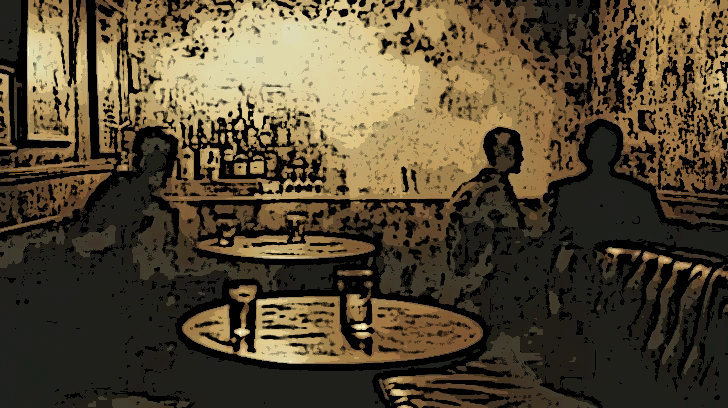
In my mind’s eye, it’s always the Swan, smoky and dim, last orders have been called, and as the holidaymakers and those not in the know grab their coats and leave, we wait expectantly.
It was not a dead cert, but the odds were better than most, so on the whim of the landlord, we wait. And wait. A hush descends. The curtains are closed. The bolt is drawn, and the munera begins. If you only wanted a quick pint, you were shit out of luck.
Here, gladiators came to do combat, no swords as weapons, but something just as deadly: cider so dry you needed a drink to recover, strong enough to put hairs on your chest, but not strong enough. So it needed the addition of a gin for added body.
Served in glasses with an X in marker on the bottom, glasses reserved for cider, for even after they had been through the glass washer, they would make any lager served in them go flat.
Warriors. A brotherhood. The landlord, the high priest, and we gathered here in combat seeking Valhalla at the bottom of a glass. Like made men, there was no early exit from this society. Omertà: both a code of silence and the environment in which we drank.
I’d tell you more if I could, honestly, I would, but it’s not the fear of retribution that brings my silence. Like every such evening, it all becomes hazy as a lazy mind is marinated in cider.
Often, all I wanted was just one more pint; no chance, it was all in or nothing, thus I knew I was walking the plank and getting wet was just a matter of time.
At some stage, someone would crack when the voice in their head said they’d had too much and they needed to go home. Some had simply gone to sleep in the corner rather than suffer the indignity of being a jibber, the first to jib out and leave.
As the lock was drawn and they left, the spell was broken, and the rest would slowly drift away, like the dregs in the barrel, to awaken the next day with little recollection and sore heads, feeling like we had been mugged, and after looking in our wallets, unsure still.
Yet always in the glow of manly bonhomie and an esprit de corps born of drinking with brothers in arms. And of course, fathers. What I’d give for a pint with him today. And his arms.
The same thing happened with my brother-in-law Paul, only this time in London at the Ten Bells, Spitalfields, not that it was ever called that by the locals. We are not talking of the trendy watering hole it is now, but its ghost, known to all who drank in her as the “Jack the Ripper” or just the “Jack”.
Back then, Spitalfields was very different. Rough, ready, dirty and tough, prostitutes in the doorways turning tricks with punters in the cardboard sheets and debris of the markets.
A land of typesetters and fruit and veg merchants. But the same rituals, the same rites of passage.
Once again, the doors would lock, the thick, musty, deep velvet curtains would be drawn to hide the lights and muffle the sound, and once more battle would commence.
How much money would I spend like this, in the muffled silence of a church, talking nonsense and slowly getting pissed.
Who knows what wrongs were righted, or rights wronged, but all with the same bonhomie and bravado of brotherhood as we parried and thrust with pints instead of sabres. All I know is that they were good times. But aren’t they all.
Then, as if by some miracle, I had my own passport to this mythical land. My Eden, The Bricklayers Arms, West Norwood, what a strange rite of passage that was, for a year, no one would talk to me and my mate Doug.
But we paid our dues, bought our pints and packets of crisps, all the same with due deference respecting all the Irish regulars, for indeed it was as Irish as Irish can be.
A year of being ignored when the tickets for the Sunday meat draw were held, a year of being tolerated, never celebrated. You knew that when last orders were called, it was code for fuck off. And fuck off now. Then one Sunday, not a word was spoken, but you were offered a ticket.
An event every bit as meaningful and meaningless as rolling up one trouser leg and uttering an oath to the Grand Master. That was our passage into this secret society. Soon we were able to drink all Sunday night, join the Monday club and occasionally the Tuesday one too.
Sod the Masons and the Groucho Club, this was a club that had real benefits too. Sworn to secrecy, again. Then the licensing laws changed, and a whole culture of silence silently died.
I think that secrecy was the problem. How could you mourn something that did not exist? So, nobody noticed. Nobody raised a glass to the lock-in. No one wore black armbands or wrote poems about traffic policemen wearing black cotton gloves. They should have.
It seems that task is now left to sixty-year-old has-beens who, in some flash of horse piss-inspired inspiration, suddenly recalled those rituals and rites and all that had been lost. And felt it deeply. Felt the sadness that its passing was never even noticed until now.
So, ladies and gentlemen, but I suppose mostly gentlemen, for it was mainly men in those smokey dark pubs, stop all the clocks and raise a glass in toast, for I give you the lock-in.
God bless her, and everyone who ever sailed to those far lands in her. God bless the lock-in.
Leave a Reply