
As our Seaking swooped low across the desert, the Ride of the Valkyries playing in my head, I looked out of the door where the gunner sat. I could not help but notice Iraqi T-72 and T-55 tanks laagered in neat berms, each with a precise scorchmark on the turret.
When we landed in Basra, I mentioned my observation to one of the officers who had flown in with us; his reply was as chilling as it was sobering. “Yep, they fought a great 20th-century war, trouble is we fought a 21st.”
As pundits babble on over the airwaves about the war and the prospect of a ground invasion and even the ludicrous idea of the 82nd Airborne parachuting onto Kharg Island, I can’t help but recall that conversation and think that history is about to repeat itself, only this time it is the Americans who are about to get slaughtered.
Now, I could be wrong. I am the first to admit that when it came to the Russian invasion of Ukraine, I was massively wide of the mark in my estimate that the Russians would defeat Ukrainian forces in less than a month, and that was being optimistic.
However, the reason I got that “wrong” was a failure to update my mental model to include the power of the defensive in an age of persistent kill zone surveillance. War had changed, yet I was still thinking in terms of an older battle space, just like the Iraqis.
The maxim that “generals are always preparing to fight the last war” has never been truer. War is always changing, evolving, but now that the pace of change has increased exponentially, there is no time to play catch-up on the battlefield.
Exactly the same dynamics that caught the Russians off guard are exactly the same forces that make any US invasion of Kharg Island landing so terrifying.
In Ukraine, the “collapse” did not happen because cheap drones and precision sensors made it impossible for a large, armoured force to move without being seen and struck. On Kharg Island, that same kinetic dynamic is magnified by the island’s tiny, fixed geography.
Any romantic notion that US Marines hitting the beach is going to be like Saving Private Ryan or the 82nd Airborne whispering down in the parachutes is going to pan out like an episode of Band of Brothers is truly mistaken. It is more likely this will play out like Terminator or Starship Troopers.
Let’s forget any notion that the Iranians are behind the US in any technological arms race. They are good at war, better at asymmetric warfare, and let’s face it, they have had a lot of practice. And even more time to plan and wargame.
Lest we forget, during the Iraq and Afghanistan wars, coalition forces came under increasing pressure from IEDs that paralysed the battlefield. It was bad enough with simple devices, but when the Explosively Formed Projectile (EFP) arrived, the war was taken to another level.
Unlike a standard IED, which relies on a blast wave and random shrapnel, the EFP is a precision-engineered kinetic weapon, a gift from the Iranians, not just the technology, but a parts kit too.
During the Iraq War, U.S. intelligence (and forensic teams like CEXC) traced EFP components, specifically the precision-milled copper liners, directly back to workshops in Iran.
Yet the boffins and back room boys and girls in Tehran did not rest on their laurels like the disrupters they were. They had a war to win, and the only way to do so was to grow systems, build weapons that would make Satan blush and plan how to use them.
With the vile, vicious logic of war, it was perhaps inevitable that the EFP would grow wings and take to the sky, the bastard offspring of the drone with the Top-Attack EFP.
Thus, the IRGC and its proxies (Hezbollah and the Houthis) have integrated EFP warheads into smaller, quieter drones like the Shahed-101 and specialised FPV (First-Person View) quads.
As a result, the war in Ukraine has become a hellish nightmare vision of war, where moving from cover is almost an act of suicide. Factor in AI, and you have a scenario as terrifying as any sci-fi movie, as terrified soldiers on both sides are picked off like Non-Player Characters (NPCs) in some brutal video game.
As President Trump prepares to unleash hell as only he can, with the whispers that the 82nd Airborne are going to parachute in, in some made-for-TV spectacular live-streamed around the world and as the ramps go down, while the US Marines storm the beaches live on TikTok, they are running into a kill zone.
During the Second World War, before the battle of Tarawa, an atoll in the Gilbert Islands, the Japanese commander, Rear Admiral Shibazaki, famously claimed, “A million men cannot take Tarawa in a hundred years.” This mirrors the modern Iranian confidence in their “Mosaic Defence” with the idea that a small, fortified space can be made too expensive to capture.
Then, as now, every target had been pre-identified and pre-registered by their weapons systems; only today, much of the target acquisition and control systems have been automated and are autonomous.
As those boots hit the sand, they will come under a deadly barrage that not only knows where they are but where they are going to be, and they will be met by drone swarms, smart mines, Uncrewed Surface Vessels (USVs), and perhaps a few old-fashioned troops.
The Japanese had every inch of Tarawa mapped for their artillery. At Tarawa, the Marines did not die in “battles”; they were picked off while wading through chest-deep water trying to land. On Kharg, this role is filled by the EFP drone and its deadly brothers. It doesn’t wait for the Marine to reach the beach; it hits them while they are still boarding the Amphibious Combat Vehicles (ACV) or Landing Craft Air Cushion (LCAC).
In 1943, the might of the US discovered that a tiny speck of coral, if sufficiently fortified and pre-registered, could neutralise a superpower’s momentum. In 2026, Kharg Island is the ‘Digital Tarawa.’ But where the Japanese had machine guns and fixed artillery, Iran has AI-driven drone swarms. The ‘bloodbath’ isn’t just a possibility; it is a calculated step in the evolution of war.
What about Air Superiority, I hear the armchair generals cry? For 70 years, air superiority meant owning the “blue sky,” those high altitudes where jets like the F-35 or F-22 rule while bombing or firing stand-off weapons at those poor, defenceless troops on the ground.
But as we’ve seen in Ukraine and during Operation Epic Fury, there is a new, deadlier domain called the “Air Littoral” (the space from the ground up to about 3,000 feet). While the US and Israel have won the air war and dominate the blue sky, it is not the same closer to earth, for ownership of the high sky does not protect the ground or the boots standing on it.
The invasion of Iran will be the first-ever amphibious and airborne operation in the age of the drone. Yet all the Donald sees is a photo opportunity, a chance to display his toys and the might of the US military.
Paul Verhoeven’s Starship Troopers wasn’t just a movie about bugs; it was a satire of a society so blinded by its own “Made-for-TV” propaganda that it sent thousands of young, unarmoured soldiers into a meat grinder because the leadership fundamentally misunderstood the enemy’s capability.
That was fiction, this is fact. This war could never be won at 20,000 feet; instead, it will be lost at 6 feet, the height of a man, the trajectory of a drone and the depth of a grave.
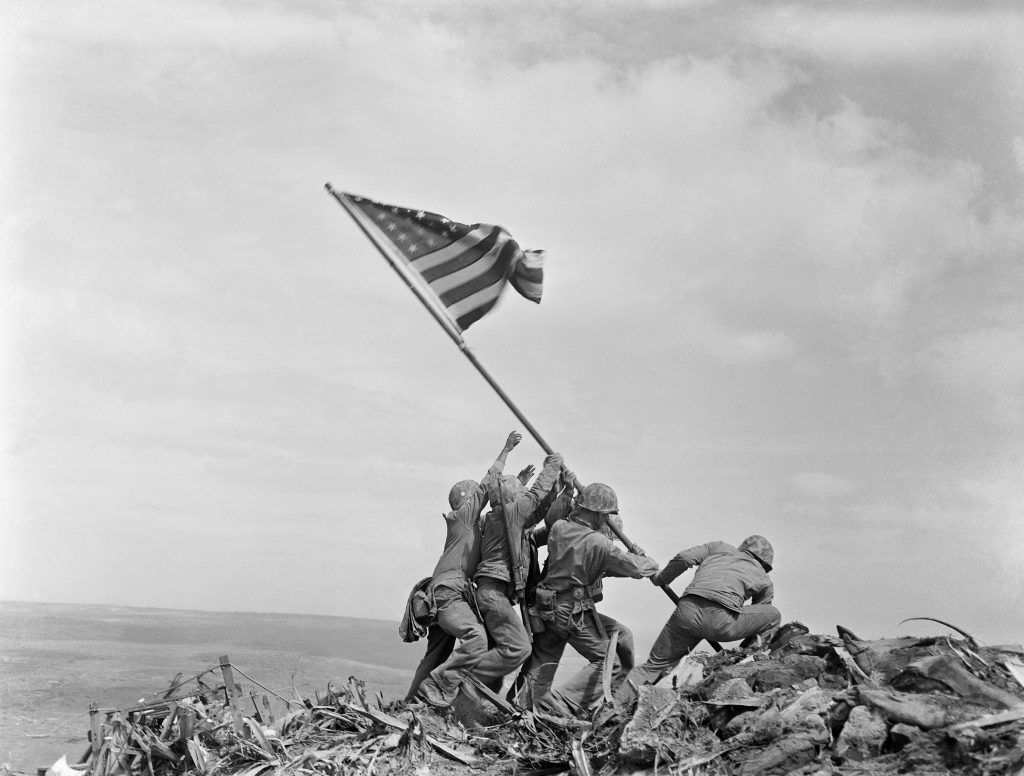
There will be no heroic victory mythologised through the lens of time, there will be no flag waving or the victorious flying of flags. This war will see no Raising the Flag on Iwo Jima moment for Trump to bask in reflected glory.
Sadly, the only time flags will be seen is when draped over the caskets of the poor, bloody infantry who had to pay for Trump’s rhetoric and are coming home, and coming home to roost.
Leave a Reply