
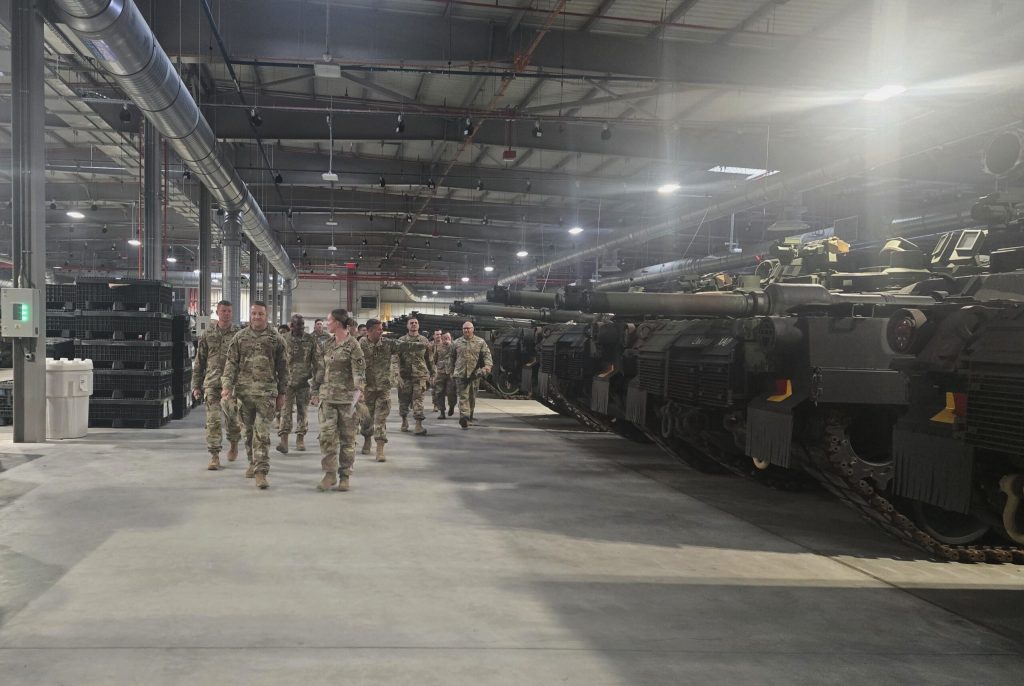
One of the facilities at the Powidz Army Prepositioned Stocks-2 worksite. (U.S. Army courtesy photo)
I don’t know about you, but the thought of moving house fills me with dread. In fact, it was so bad last time that I said if the time arose and we had to do it again, I’d take all my possessions to the back garden and burn the fucking lot, and that was only a flat. Hold onto that thought.
Picture, if you can, that problem on a scale almost unimaginable, and rather than boxes of bric-a-brac, old tat and cartons of old magazines, we were talking of flat-packed hospitals, X-ray machines, field kitchens and M1 Abrams tanks, nearly a million square feet of the stuff all sitting in suspended animation waiting for war to break out.
What I’m describing is the “APS-2 Zutendaal”, Belgium, comprising 28 warehouses with about 990,000 square feet of climate-controlled interior storage space, plus an additional 77,000 square yards of outdoor staging, 27 maintenance bays, and 12,000 square feet of hazardous material storage. Think of it as one of the US Army’s go-bags, one the size of 81 football pitches.
During the Cold War, the US maintained colossal forward stockpiles in West Germany under a program called POMCUS (Prepositioned Overseas Material Configured to Unit Sets), all stored in facilities just like those at Zutendaal.
Tanks, jeeps, artillery shells, small arms ammunition, big boots, water bottles, webbing, lots of kit, lots and lots of it, enough to equip entire armies arriving by air from the continental US. The idea was simple: build an airbridge and fly in the soldiers and tank drivers, not the tanks.
Admittedly, after the Cold War, these stocks were dramatically reduced, but they were never eliminated. Today, the program is called Army Prepositioned Stocks-2 (APS-2), and it has been substantially expanded since Russia’s 2022 invasion of Ukraine.
The APS-2 program is described as the “logistical foundation” of US Army Europe’s commitment to readiness. If we think of the US forces as NATO’s Superman, then this is his cape, tights and call box.
APS-2 is the largest of seven APS regions worldwide and has been significantly expanded in recent years, and now holds sufficient pre-positioned equipment in Europe to fully arm two armoured brigade combat teams.
The six known APS-2 depots in Mainland Europe are: Coleman worksite, Mannheim, Germany (under Army Field Support Battalion-Germany); Dülmen, Germany (also AFSBn-Germany); Eygelshoven, Netherlands; Zutendaal, Belgium; Livorno, Italy; and Powidz, Poland.
By maintaining these huge stocks of forward and ready equipment, munitions, and materiel, it increases the speed and flexibility of the US Army to react during times of cooperation, competition, and, of course, conflict. All of which is a long-winded way of saying it’s a massive amount of equipment that amounts to the surplus store of your dreams, or nightmares, depending on your point of view.
Now trying to second-guess Donald J Trump is akin to herding cats; blind ones at that, however, what can be established is his deep dislike of NATO, and while even Trump probably doesn’t really know what he’s going to do next regarding it, I’ll wager he has no idea of the scale of the problem that withdrawal from the treaty would create.
At this stage of the game, Trump is essentially the Captain of a supertanker applying the anchors; even if he were to order US forces to leave NATO today, it would take decades for its footprint to be erased.
We’re talking about millions of square feet of climate-controlled warehousing, with over 5,000 major items at Powidz alone, and hardstanding storage across six countries in this just-in-time delivery system, in what is the shelving on the tip of the spear.
It took the US military decades to stock these shelves, and you can’t reverse that in a single presidential term. The 2022 activation pushed out 600+ vehicles in one operation, and that was considered a major logistical feat.
Running it in reverse, across six countries with host nation agreements, port allocations, rail scheduling, and shipping availability, would take years even if ordered tomorrow.
Even then, it’s not that simple. The Powidz site is a NATO-funded project, in fact, the largest NATO infrastructure investment in 30 years. The US doesn’t simply own it in the way they own a warehouse full of MREs back in Wyoming.
Unwinding the legal arrangements, compensation frameworks, and Status of Forces Agreements (SOFAs) in each host nation would require negotiated exits, not unilateral departure. Germany, Belgium, the Netherlands, Italy, and Poland all have their own leverage in that process.
Trump can huff, and he can puff, but it may take more hot air than even he can muster to blow this house down, and that’s before you consider the inevitable institutional resistance to his plans.
The US military’s institutional culture actively resists such rapid drawdowns. After the Cold War, it took the better part of a decade to close bases and repatriate equipment from Germany, and that was with the bipartisan political will to do so.
Let’s not forget, career officers, contractors, logistics commands, and Congressional defence committees all have their own agendas and structural incentives to slow-march any retreat. The 405th Army Field Support Brigade alone employs a substantial host-nation civilian workforce, and those are politically salient jobs in European constituencies with their own lobbying power.
However, while Trump can’t remove the equipment, he can, in the short term, sabotage it; he doesn’t need to remove those M1 Abrams to throw a spanner in the works and degrade combat capability; to do that, all he needs to remove is funding. And the spanner.
After the Cold War drawdown, a significant portion of POMCUS equipment that wasn’t shipped home was simply left to rot thanks to reduced maintenance budgets. Think of it as a room full of fine suits left alone for the moths to eat. On paper, they are still there, but if you wore one out, you’d look like a pauper.
By the late 1990s, inspectors were finding that equipment that was nominally “ready” on paper was actually in a dreadful condition, with poorly maintained vehicles and degraded systems, many missing components cannibalised for other uses, with documentation that simply didn’t match reality.
It took considerable effort and money post-9/11 and again post-2014 to bring things back up to standard. That is NATO’s Achilles heel.
These aren’t simple pieces of kit, and while you might think of a tank as a mighty unstoppable beast, in reality, it is a Swiss watch that needs regular servicing. For example, an M1A2 Abrams is an extraordinarily complex mix of integrated systems that can’t sit for years neglected like some barn find Ford Anglia.
It needs to be stored in a continuous climate-controlled environment to prevent corrosion of electronics and optics, plus it needs to be started and run regularly, with regular fluid changes. Then it needs software updates, yes, software updates, to the fire control and navigation systems; all of this is performed by an army of trained technicians, many of them local civilian contractors.
Cut the budget, and you don’t lose the tank, but you do lose the capability and threat the tank represents. Within a few years, it becomes nothing but a huge, expensive, steel paperweight. The Powidz facility, proudly described as the most modern prepositioned stock site in the world in 2024, could, within a single presidential term, become a very expensive elephant’s graveyard if maintenance funding dries up.
That is the real threat, not the bluster, not the huffs, not the puffs, not the threats to leave NATO, but death by a thousand moths, that the US presence in Europe becomes one of those paper tigers that Trump loves ridiculing so much.
The problem is that nobody outside specialist defence circles notices a maintenance backlog. There’s no dramatic news moment, no political controversy, no allies formally protesting, nothing but cobwebs and metaphorical moths eating those fine, expensive suits.
The equipment is still there, Trump can point to it and say, look, America remains committed. But military planners on both sides of the Atlantic would know the truth, and so would adversaries and bad guys with half-decent intelligence services.
This raises the spectre of Uncle Sam half asleep in a threadbare uniform, scruffy, degraded but nominally present, and that creates real strategic ambiguity about actual US capability and commitment.
NATO planning depends on being able to model what forces can actually be deployed in a crisis, not on a spreadsheet. If the answer is we think we have the equipment, well, we do on paper, but we’re not sure of its readiness, or if any of it works, that’s not a deterrent but the roar of a paper tiger.
Putin, notably, is quite good at reading the tea leaves over that kind of strategic gap between declared and actual capability. And while Trump is not going to take all his toys to the back garden and burn the fucking lot, he might do the next best thing and leave them to rot.
Leave a Reply