
There is something quite chilling when you think of the site of an old quarry in Wiltshire, whose stone was used in the creation of the now notorious Salisbury Cathedral, having such a direct role in the destruction of Dresden’s iconic Frauenkirche (Church of Our Lady), but that’s irony for you.
It is ironic too that, when on 2nd June 2025, the PM Sir Keir Starmer announced, as part of the Strategic Defence Review, that the UK would build at least six new munitions and energetics factories, backed by £1.5 billion of investment, that same site had been closed for thirty-five years.
Work at the quarry stopped in 1935 when, thanks to the increased use of concrete for building purposes, demand for limestone fell, and the surrounding land was bought by the Air Ministry in 1936 as a site for an ordnance store.
Now, thanks to a quirk in our geography and geology, if there was one thing we did well in this country, it was underground ammunition storage, and that old quarry, RAF Chilmark as it became, was just about perfect for the job.
At its height during World War II, it was the strategic hub in the European war and bombing campaign, where bombs, artillery shells and small arms ammunition would be safely and securely stored out of reach of Nazi bombs following manufacture but before their dispatch to the theatre.
Think of it as freezers at the centres of a huge, yet grisly, distribution network and the forerunner of the just-in-time system that keeps you in fish fingers today. Only, instead of frozen cod, it was 500lb General Purpose (GP) bombs and two-inch mortar shells.
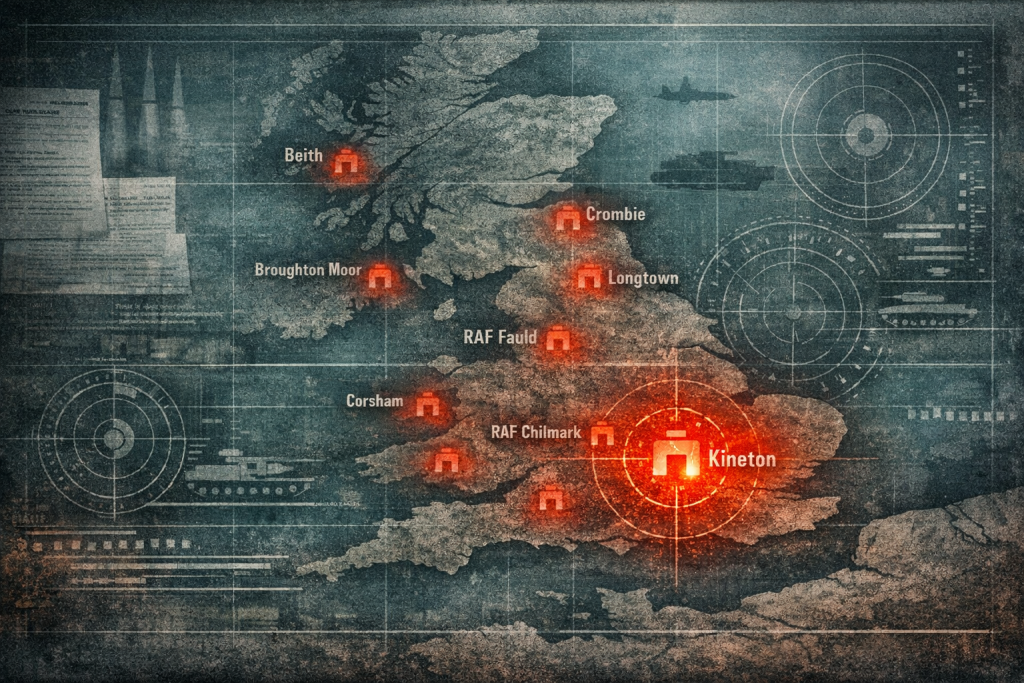
RAF Chilmark was just one of many strategic hubs alongside the likes of RAF Fauld, Staffordshire, the RAF’s northern depot that has the dubious honour of being the site of one of the largest non-nuclear explosions in history, when between 3,500 and 4,000 tonnes (3,900 and 4,400 tons) of high explosive military ordnance detonated.
There was also RAF Harpur Hill, Derbyshire, used for chemical weapons disposal post-war, however the RAF was not the only stakeholder in this vast distribution network.
The Army had built the vast Central Ammunition Depot at Corsham in Wiltshire, a labyrinth of requisitioned quarries including Tunnel Quarry, Ridge Quarry and Eastlays, where Tunnel Quarry alone was divided into ten districts of five acres each, complete with its own railway platforms, power station, barracks and ventilation system in what was effectively an underground city, a feature of the site later repurposed as the government’s backup seat of power in the event of nuclear armageddon.
The Royal Navy had its own dispersed network: sixty underground magazines at Dean Hill near Salisbury, ninety at Trecwn near Fishguard in Pembrokeshire, a further depot at Ditton Priors in Shropshire, six underground magazines at Crombie near Rosyth, and a converted colliery at Broughton Moor in Cumbria.
Dispersal, depth and redundancy were the doctrine. A perfect ecosystem of interlocking systems, linked by rail. One that no single strike, however precise, could knock out. Or indeed hinder Britain’s ability to sustain a war. However, it was not immune to the whims of politicians.
Almost before the end of the Second World War, the coming peace dividend meant that, while it was almost perfect from a logistical point of view, it was seen as an expensive luxury, and ripe for cuts or being repurposed for “cheap” nuclear bunkers.
Even during the Cold War, the sites were neglected or closed, a trend that accelerated following the fall of the Soviet Union. The pattern was striking.
Britain built an extraordinary dispersed network across the geology of the whole country, north to south, east to west. Then quietly, without any fuss or fight disposed of almost all of it.
Just like the Government Pipelines and Storage System (GPSS), 2,400km of underground pipeline originally built to supply fuel to RAF airfields during World War II, no one noticed or kicked up a fuss.
Again, the MoD sold a strategic wartime asset built at taxpayer expense for £82 million, then immediately signed a contract to pay nearly three times that amount to use it back, having previously paid nothing for it.
Britain’s 1990 “Options for Change” defence review triggered the post-Cold War sales of all those strategic assets, which didn’t just close ammunition depots, but set a philosophical direction of travel that persisted across various governments for three decades. If the state owned it and could sell it, sell it. It was a deeply flawed doctrine.
It was built on the assumption that once the Cold War ended, war had ended. That the world was full of sunshine, unicorns and rainbows. That peace today would guarantee peace tomorrow. Peace off.
It’s one thing to say that the UK would build at least six new munitions and energetics factories, backed by £1.5 billion of investment and another to have somewhere to safely store the munitions they produce, for that would gobble up that investment in the blink of an eye.
As it stands, a succession of governments has allowed our defence infrastructure to atrophy to such an extent that there is only a single viable storage site for the nation’s munitions.
So, thirty years after “Options for Change” set the disposal machine in motion, this is where we find ourselves. Defence Munitions Kineton, 2,200 acres of above-ground storage in rural Warwickshire, is now the largest ammunition depot in western Europe, storing more than 60% of everything the MoD owns.
The remaining operational sites, DM Gosport in Hampshire, DM Beith in Ayrshire, DM Crombie in Fife, DM Glen Douglas in Dunbartonshire and DM Longtown in Cumbria, are either naval-focused, geographically remote, or too small to carry the weight of a serious land war in Europe. Our Achilles heel is a Single Point of Failure.
Kineton does the heavy lifting alone. Its bunkers are hardened with concrete, earth banks and blast walls designed to stop any accidental internal explosion causing a chain reaction of sympathetic detonation where one igloo sets off its neighbours.
They are not fully underground. They are not hardened against a precision strike, a cruise missile, or indeed a small, well-placed, well-trained special forces team delivered by Uber from Banbury, something that could cripple it and the nation’s ability to fight any war.
With that in mind, those promises of six new munitions and energetics factories sound as misguided as the “Options for Change” document that set the ball rolling thirty-six sorry years ago.
Leave a Reply