
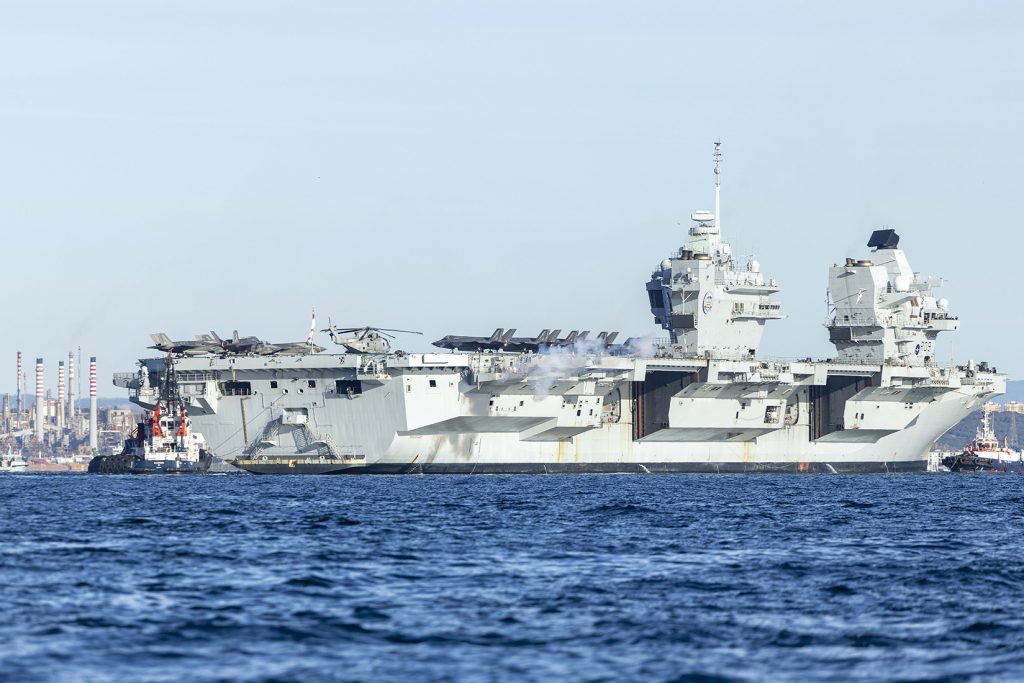

Now, I never thought I’d say this, and it irks me in the extreme to do so, but I find myself agreeing with some of Donald Trump’s rhetoric. What’s even worse, when it comes to our navy, especially where it concerns the Queen Elizabeth Class of Aircraft Carriers, which aren’t even the right answer to the wrong question, I feel that Pete Hegseth might have a point or two, too.
Now, let me be clear about something from the outset. I do not like Donald Trump, and Hegseth even less, but if you’ve read my blog, you already know that. Nor do I trust their motives. But even a broken clock is right twice a day.
Trump’s comments about the Royal Navy were designed to bully our prime minister into supporting a war with Iran. One that has no clear objectives I can see, other than appeasing Vladimir Putin, and one which most of this country wants no part of.
While Pete Hegseth’s “big, bad Royal Navy” jibe was delivered with the smug, self-satisfied smirk of a man trying to embarrass someone into compliance, a bully saying come here if you think you are hard enough, yet one who would run a mile if you did, it landed hard.
However, when the First Sea Lord, Gen Sir Gwyn Jenkins, the highest-ranking naval officer in the country, goes and tells a Swedish newspaper that he does not believe the navy is ready for war and won’t be until the end of the decade, that American sarcasm stops being political theatre and starts being a diagnostic report.
The curse of good enough strikes again, only this time it’s not free, and while good enough in peacetime is bad enough, come war, and the time you need to back up a threat with a punch, it’s a disaster.
So, shipmates, parking for one second the issue that the Royal Navy, once the pride of the British Empire, the very projection of power that gave us the lexicon “Gunboat Diplomacy”, doesn’t have the ships or crews to blow the skin off a rice pudding, let’s consider the farce of our aircraft carriers.
While a US carrier battle group (CVBG) is a mighty thing indeed to behold and a true projection of power, the British attempt is a running joke without a punchline. The standard critique of the Queen Elizabeth class is that it is simply the wrong answer to the right problem.
What we should have done was build something different; smaller carriers, more frigates, kept the Albion-class assault ships, and retained the old minehunters in Bahrain. All of that is true.
But the deeper problem is structural, for both the question and the answer are wrong. We never actually asked, “What does an island nation like Great Britain actually need from its navy in the 21st century?”
Instead, we considered, “How do we look like a superpower?” And then, and this is the part that should truly embarrass everyone involved, the military top brass, both Labour and the Tories, we failed to even answer that question correctly.
Consider what a real supercarrier brings, like the toys that Trump so likes to play with. I can just picture him in the bath with his admiral’s cap on.
The game changer and force multiplier is this: the American ships have catapults. Those that let their jets take off fully loaded with fuel and with the heaviest bombs in the arsenal. Plus, they have the E-2D Hawkeye, an airborne radar station that sees everything for hundreds of miles, letting the strike group know what’s coming long before it arrives.
They also have EA-18G Growlers that can blind and jam enemy air defences in a coherent strike package. They have nuclear propulsion, which means the ship itself never needs to stop for fuel, unlike HMS Queen Elizabeth and HMS Prince of Wales, which trail long logistical fuel tails.
While all we have is a couple of boutique flying franchises, a US carrier is, as one naval analyst put it, a factory for flying, one capable of generating 270 combat sorties in a single day at surge capacity.
We have none of that. Our carriers use a ski-jump ramp, which means our F-35Bs have to trade fuel for weapons on take-off. They have a combat radius roughly 200 miles shorter than the American version, and when they do get to the target, they carry a smaller bomb load.
Our “eyes” are Merlin helicopters instead of fixed-wing radar aircraft, which means threats pop over the horizon much closer and much faster. We have no dedicated carrier-borne electronic warfare aircraft at all, but despite all that, the catapult question is where political and military failure really becomes farcical.
When, in 1998, Tony Blair’s Strategic Defence Review identified the need for new carriers to replace the rapidly ageing Invincible-class light carriers, I’m sure the admirals were thinking of something like the fourth Ark Royal of 70s fame, complete with Rod Stewart, arms outstretched as he sang “Sailing”.
However, Blair clipped their wings, and what they got was a compromise, and as Alec Issigonis so famously said, “A camel is a horse designed by a committee”, although in this case it was an elephant, a white one to boot.
It didn’t get any better when in 2010, David Cameron’s government decided we should fit the ships with American electromagnetic catapults, allowing us to operate the more capable F-35C. This was announced with fanfare. It would, ministers said, make us genuinely interoperable with the Americans and the French. It was indeed the right call.
Two years later, they admitted they hadn’t checked whether the ships already being built could actually accommodate catapults. I bet you know the answer before reading it. Of course, the answer was no, not without ripping the hulls apart and spending an extra two billion pounds.
They quietly switched back to the original ski-jump design, having wasted roughly £100 million on the assessment alone, and we continued to paint lipstick on a pig. Permanently locking us into the F-35B weapons system rather than the more capable F-35C, or the Dassault Rafale M, which the Americans and French fly and which cannot land on our ships.
As the Conservatives will tell you, our toy story is not entirely a Tory story. Labour designed these ships in the first place. They are the ones who failed to ask or answer the right questions, asking only how much it would cost.
They chose the ski-jump to save money, and they chose gas turbines rather than nuclear propulsion, again to save money. Then they signed contracts so rigid that any change would trigger enormous financial penalties, which is why the Tories felt forced to attempt the catapult conversion rather than simply starting again.
The catapult fiasco is a case study in bipartisan procurement failure, which is precisely why nobody uses it as a political weapon. Both sides know that the circular firing squad would shoot them both in the foot. So they hope it will all quietly go away if no one looks under the carpet. No one doth protest too much.
Nor do they want to draw your attention to this: in the current conflict, with our current capabilities, without the ability to clear mines, a British carrier in the Strait of Hormuz is just a very big, very expensive target the US Navy would have to protect.
They would rather hide the one detail in recent reporting that crystallises this story better than any other. For twenty years, Britain maintained minehunters and a support vessel in Bahrain, specifically because the Navy knew that in any crisis with Iran, mining the Strait of Hormuz would be the first move. We were world-class at this. It was our niche, our contribution, the thing we actually did rather than merely talked about doing.
On a small scale, we really did punch above our weight, and the rest of the world’s navies knew that. However, in that classic cock-up of military procurement, we scrapped one working weapons system on the promise of an even better one at some notional point in the future, just like they did with the BAE Systems Nimrod MRA4. Do they never learn?
In the past year, we removed the last three minehunters. One was towed home in January. The others are being retired. We did this as Iran became an active conflict zone, all on the promise of the Maritime Mine Counter Measures (MMCM), an uncrewed remote systems solution that includes uncrewed surface vessels, basically robotic boats operating from a mothership or shore, and autonomous underwater vehicles, in other words, drones that map and detect mines.
The issue is not that nothing exists, but that it is not fully operational at scale, not persistently deployed in places like Bahrain, and it relies on support ships and infrastructure that are not fully in place. It replaces the continuous, on-the-ground presence the old minehunters provided with a promise of jam tomorrow. It is not as if the MOD needed a crystal ball to predict this mess.
Thus, Trump’s instruction to Keir Starmer not to “bother” sending the carriers was not just a bully’s jibe. It was a tactical observation. Without the ability to clear mines, a British carrier group sailing into the Gulf becomes a massive, expensive liability that the US Navy has to spend its own resources protecting. We removed the one capability that made us genuinely useful and replaced it with nothing but promises.
The Queen Elizabeth class are extraordinary ships. They are engineering achievements. At 65,000 tonnes, they are the largest warships Britain has ever built. The automation is remarkable indeed; they run on a crew of around 700, where an American carrier needs 4,500.
In a narrow technical sense, they are marvels; they look impressive in port and would look lovely at a Spithead review. But what they actually are, as opposed to what they were sold to the nation as, is a very large anti-submarine warfare platform that will evolve, slowly and expensively, into a drone carrier.
In the North Atlantic, hunting Russian submarines, the class is genuinely useful. But that is not the global strike capability or the global fist that was promised when the steel was first cut. In comparison to the US Navy, it is a carrier in name only.
What we have is a regional defence vessel, and that is a mission that could have been accomplished more cheaply and more sustainably with a different set of ships entirely. Instead, we were mis-sold a Ferrari when all the Navy needed was a fleet of well-maintained Land Rovers.
Worse, we scrapped the Land Rovers to pay for the Ferrari, and now we cannot afford the insurance, and that is no insurance against war. The money would have been better spent on more helicopters for those Albion-class assault ships and more and better-equipped special forces and marines. Troops to embrace doctrines, not dreams.
I want to be precise about what I am and am not saying. I am not saying Trump is right about Iran. Nor am I saying Hegseth’s motives were honest. And I am definitely not saying Britain should have joined an offensive military operation that lacks a clear objective and which risks inflaming a region already on fire by literally pouring oil on troubled waters. But what I am saying is that the sarcasm is rooted in substance.
When the First Sea Lord says we are not ready for war, he is not being falsely modest. When critics note that it took three weeks to get a single destroyer to Cyprus, they are identifying a real failure of readiness. When the House of Commons defence committee says it has “grave concerns” about the navy’s capacity to respond to a Middle East crisis, it is not engaging in partisan point-scoring.
We spent decades buying prestige and calling it capability. We bought into the idea of a carrier navy but forgot to buy the navy that makes a carrier useful.
In layman’s terms, we bought the train set but either forgot or ignored the fact that, to function as it shows on the box, we needed the track. That, or toys just don’t work like the big rich kids down the block.
The Queen Elizabeth class is not even the right answer to the wrong question, for it is a magnificently expensive monument to our confusion about what kind of country we are and what kind of military we can actually afford. That is not Trump’s fault. That is ours.
Leave a Reply