
Strange how it’s the little things that almost derail an operation, no matter how well drilled, how planned, always expect the unexpected. In this case, it was the simple fact that the Uber app had been offloaded to save space on Artyom’s phone.
The signal was so bad at the railway station that it was taking an age to redownload. The train had been late, but they’d expected that. Now, thanks to that dodgy connection, they were six minutes behind schedule.
Calm and collected, Artyom did what any such expensive and exotically trained operative would do and moved to the far side of the car park. Bingo. The Uber was booked, and Ahmed would be here in ten minutes.
As the driver pulled into the curb, he was surprised as the lone figure stepped out of the shadows and appeared doleful in the headlights. Despite the smile, he had an air of malice that Ahmed had seen countless times in the secret police of his own country.
As Artyom opened the door, he almost imperceptibly nodded to the car. A signal, and three others stepped out, into the light and into the car. Two men, one woman. Her smile sent shivers down Ahmed’s back.
Almost like a silent movie, the three actors entered the Toyota Prius, not a word of dialogue, just those smiles, not exactly scary, but not real. Like they were trying too hard to be nice. Masks, every bit as effective as stockings. The only sounds were the zzzip of the car and rumble of the tyres.
Never before had Ahmed found the silence so uncomfortable, so threatening, so ominous. Was it him, or was the car too hot? With that, he felt the sting as a bead of sweat fell into his eye. Even though the whole trip lasted no more than ten minutes, to Ahmed it felt like hours.
No sooner than the phone had announced “you have arrived at your destination” than Ahmed was alone in the car. Alone with the uncomfortable feeling that he’d been in the presence of ghosts. They didn’t so much leave the car but flow out of his life.
As Ahmed pulled away from the 24-hour storage units, not only did a huge sense of relief flow over him, but an overwhelming urge to put the whole thing to the back of his mind and never speak of the night again, but fate had other plans for him.
Come on, you must remember more than that said the anti-terrorist officer, gently probing Ahmed for more detail, “No, no, they were as scary as fuck, and I just wanted to forget the whole thing”.
At the lockup, Artyom opened the app on his phone, and the door to the unit popped open, silently, efficiently. They were the ghosts in the machine. Up until now, they have just been names in the cloud. Now it’s time for the virtual and real worlds to collide.
The same technology that lets you order a pizza from the train, or buy your mate a pint in Spoons in Perth, also lets you rent a van and a lock-up. And if you have the right teams working for you as anonymously as any ghost or spook.
Capeka, for that was the woman’s name, took Artyom’s phone and, using the map, guided herself about 20 meters down a sideroad to a lane behind the storage units where a pristine new Ford Transit was parked.
Using the app, she unlocked the van, took the key from the glovebox and reversed it up to the storage unit. Until this point, the team had not said a single word. Until this point, they’d not needed to.
Inside the storage unit, you could just make out a single pallet, and the slight scent of gun oil, no, not gun oil, but the packing grease of new or recently assembled weapons. The weapons themselves had been sourced in the Ukraine, shipped to Moscow, tested, anonymised and shipped to another anonymous lock-up in Belgium.
After Artyom switched on the lighting, you could see a further four large cardboard boxes that had been stacked neatly against the side wall. Geoff, the kindly odd-job man, had left them there a few days ago when Amazon dropped them off. He did it all the time for customers; he signed for them too, a signature that would take more than a little explaining.
After about ten minutes, there was a pile of cardboard on one side of the lockup and on the other four electric mountain bikes, top of the range, the best Moscow’s extorted crypto could buy. Dmitriy has assembled them with well-oiled precision, no surprise, as the team had been training with the exact same bikes for weeks now on an airfield that didn’t exist near Chkalovsky.
Dmitriy checks them first thing, before the pallet, before anything else. He knows that they will have arrived with a 60 per cent charge; he just needs to top them up. He plugs all four in. And four Apple watches. Conveniently, the lockup has enough standard 13-amp sockets. Dmitriy made sure of that; it’s on the website.
Next came the pallet, no messy crowbars needed, paired with Artyom’s phone; he pops the lid electronically, a system made from some car security parts ordered on Aliexpress. Even if the security services were to find the crate, all it tells them is that the parts had been ordered and paid for online by a Man called Felix Dzerzhinsky, from an IP address in Finland and delivered to a caravan site in France. None of which was true.
Inside the crate were four matte black Bergans, one for each of the team: Artyom, Boris, Capeka and Dmitriy. The contents of the Bergans, each marked A to D, were identical; only the sizes of the boilersuits inside changed. Four Beretta Model 71 .22 with Tihon Suppressors. In four matte black drop leg holsters. Four pairs of ENVG-B (US Model)night vision goggles. The rest of the space was taken up with shaped charges and a clipboard with key codes Velcro’d on.
It’s obvious what the Berettas were for, and the team admitted that dealing with dogs was always the hardest part of any job, but the codes were something special. And while it had been anticipated that getting them would be one of the most challenging aspects of this mission, in the end, it had been child’s play.
It was a textbook honey trap. Brian Boxtan was a quiet man who kept his work and private life compartmented; he needed to. While homosexuality was no longer a crime in the UK, any whiff of the love that dare not speak its name in his industry would have been the end of his career, and he would have ended up running security for a bombing range in the Hebrides rather than guarding the bombs in the Shires.
The only time he felt safe to really let his hair down was on holiday in Ibiza. Safety in numbers and the anonymity of promiscuity. The trouble is Moscow knew it too. They knew how much he earned. What he spent it on and what dating apps he used. Nothing personal, they had files on everyone who worked security at the base. Logic. AI simply flagged him as the most likely victim. He wasn’t chosen. He was selected.
It didn’t take much for the strikingly good-looking man with the faint Irish accent to lodge himself in Brian’s heart and chalet. You could call it love. But it was one-sided. They promised to stay in touch, and when the young man suggested they meet for a weekend clubbing in Manchester, he could hardly wait. He knew the risks, but still he counted down the days.
When the pair finally made it to his room, he was shocked to find another man waiting for them in the room. There was no mistaking his Belfast accent. He was to the point and brutal. He handed Brian an envelope. We all know what was in it, photographs, so we don’t need to explain. There was a video too. The price of silence was the plans and key codes for the base.
Brian was a tough man in a fight, but the thought of losing face and his business was too much. Within a month, Moscow had the plans and the codes. Brian kept his mouth shut and hoped the man with the Belfast accent would do the same. Afterwards, it was too late. And what good would it do anyway?
At about four AM, the team donned their boiler suits and Bergans and loaded the van. They stopped in a lay-by about ten minutes from the base. When the SVR officer had outlined his plan, he was met with scorn and derision, “How do you expect to get in? Are you just going to drive past the main guardhouse? Yes was his reply.
Every time they had rehearsed the move at Chkalovsky, it had worked perfectly; in the pitch black of a Russian night, the team of four were like swift, silent ghosts on their bikes and zipped past the guards before anyone had noticed.
No need to synchronise watches as each member of the team was wearing an Apple Watch. 4 a.m. and Moscow, 6 a.m., a man at a desk hits enter and starts the clock running. For weeks now, this part of rural England has been experiencing power outages in the early morning. No one knows that it’s all part of the plan and that the grid had been compromised years ago.
A week ago, the base had been affected, and just as planned, the backup generators worked perfectly. The same software that allowed the private contractor to monitor the oil and fuel levels remotely had been hacked, and today the huge diesel generators won’t start as the safety system is telling them that they have no oil, and at 4 a.m., the base is plunged into darkness.
The cover of night is the team’s secret weapon, stealth, not shock, thanks to the ENVG-B (US Model), bought on the black market off a bent Ukrainian General for the price of a small flat the team could ride like it’s a bright summer’s day. With these night vision goggles, for all intents and purposes, it is.
Down the long approach road and past the panicking guards running around like the Keystone Cops with torches rather than truncheons. Down to the rows of igloos, all one hundred of them. They have practised and rehearsed this so many times that there is no adrenaline rush. That will come later. Just a steady rhythm.
One row of twenty-five concrete igloos each, sixteen keys, sixteen targets, all solved like a Rubik’s Cube by the AI, with a little help from Google Earth and Brian’s inventory.
Stop. Off the bike, Bergen off. Input code. Slide open the blast-proof door. Place the small shaped charge with the integral timer power unit and detonator, then onto the next target, leaving the door open yet unseen in the dark. But it doesn’t need to stay undetected for long.
Capeka peeled the first keycode from her clipboard, and she was off. The quickest the team had done it in training was eight minutes; this time it was six. Six minutes to win a war. That must be some kind of record. The team were speeding out past the Guardhouse towards the van before they’d had a chance to register the enormity of what they had accomplished.
Even back in the van, they did not let their masks slip; they still had a lot of work to do. At a nearby Motel, whose CCTV would develop an unfortunate technical fault that morning, the team swapped vehicles. At the same time, the power cut at the depot finished, with the power restored, all the alarms and klaxtons went off; yet they were drowned out by a much louder sound.
Then a deadly silence.
The shaped charges had not been designed by an arms dealer or a terrorist. They had been designed by engineers, patient, brilliant, state-employed engineers, who understood exactly what an earth bank was designed to do and had spent considerable time working out how to make it do the opposite.
By six a.m., the van and the bikes and the Berettas have been crushed. You’d be amazed at what the contents of a crypto wallet can do. The same for the boiler suits and Bergans that will be incinerated as medical waste alongside some not-so-dearly departed pets, a few days later.
Moscow’s extorted crypto bought the bikes, rented the lockup, crushed the van and burned the evidence. Untraceable at every stage. As is the rental car Artyom is now driving to some Identikit parkway station to drop off Dmitriy, followed by Capeka at another station and Boris at a dreary coach station.
Artyom dumps that car, which will shortly be reported stolen, and disappears into the crowds of commuters. Once on board, he checks his watch for details of his Eurostar connection via London. Bank in Moscow, as easy as ABC, the rest of the special project team are busy erasing all traces of Artyom, Boris, Capeka and Dmitriy, and with that they vanish. Not that they ever existed.
At the emergency COBRA meeting the next morning, there were audible gasps as the PM viewed the live feed from the RAF helicopter over the site. There was an air exclusion zone, so he had this vision of hell all to himself.
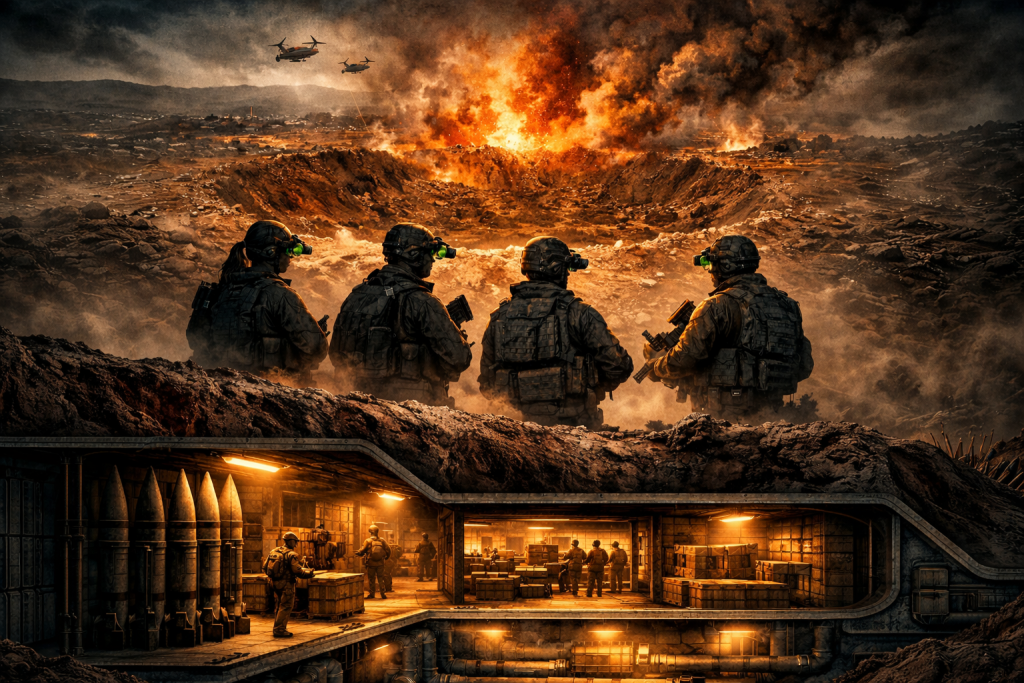
Where the depot once stood, there was a huge crater. The AI model had functioned perfectly, and while the bunkers were designed to contain any single accidental explosion, the perfectly placed charges had set off a chain reaction that destroyed the base in a flash.
There were more gasps when the Chief of the Defence Staff (CDS) explained that in that instant. that most of the country’s stocks of ammunition had been consumed by the blast. And as a result, the country was more or less defenceless.
Even before the dust had settled at the base, the recriminations started: how did it happen, how was it allowed to happen. The press had a field day. It even brought down the government. What’s the point of tanks and guns if you have no shells or bullets, as the papers were so keen to point out. We shall fight them on the beaches? Yeah, with what?
And then Moscow made its move…
Of course, thank god, all of that is a work of fiction, yet one composed of real facts. Everything in this story, the lockup, the app, the bikes, the honey trap, and that disastrous single point of failure, is real or readily available. The only thing fictional is that it hasn’t happened yet.
You don’t even need to blow it up. You just need to make it unusable, and the options for achieving that are considerably simpler than anything Artyom and his team had in mind.
An anonymous tip-off that charges have been placed on the site forces an immediate shutdown. The MoD has no choice but to evacuate and spend weeks checking every igloo and storehouse one by one. Ammunition movements stop. The army can’t draw stocks. The threat alone is the weapon.
A drone over the perimeter, not carrying anything, just demonstrating it can be done, achieves the same result. A single detonation outside the fence, close enough to trigger safety protocols, locks everything down pending inspection. Even a cyberattack on the inventory management system, leaving the stocks physically untouched but unaccountable, renders them effectively inaccessible.
In every one of those scenarios, the site is neutralised without a single door being opened. And in every one of those scenarios, the rest of Britain’s ammunition network is too small and too specialised to compensate. A single point of failure doesn’t mean it has to be destroyed. It just has to be disrupted.
The only way we can stop fiction becoming fact is to build a dispersed network of underground bunkers. Otherwise, all that new shiny ordnance the PM has promised is a liability, not an asset. For as things stand, this country has nowhere safe to store them. Dig baby, dig.
The Uber from Banbury doesn’t need to arrive. It just needs to be bookable.
Leave a Reply