
The irony that automatic draft registration should come into effect during the term of a president who received five deferments and avoided fighting in the Vietnam War is not lost upon me. You might call him a draft dodger, I won’t because that would be defamatory, besides, I’m told bone spurs are quite painful.
Like so much of what the current commander-in-chief does, it’s pointless, worse still, it’s pointless political showboating. Perhaps Trump is unaware, but his generals are not. War has changed. And how we fight it has changed, too.
On the morning of the battle of Ulundi, 4 July 1879, the massed Zulu armies faced the dawn and the assembled might of the British Empire. I’m sure they all had a noble vision of the coming battle; they knew many would fall, and for that, they were prepared. For they were warriors.
While the Zulus would not have been familiar with the words of the Roman poet Horace, especially the line Dulce et decorum est pro patria mori, they would have understood the sentiment; after all, they’d been dying for generations.
While some of the stuffy red-coated officers saw only primitive semi-naked “natives” armed with spears, for thirteen, it would be the last thing they would ever see. Again, it is rich in irony, for in sentiment those Zulus were every bit brothers in arms as those who would die later in the many “last” cavalry charges.
That dawn, the Zulus were at their zenith, simply the finest light infantry history had seen. They were a “professional” force in every sense but pay. They lived together in amakhanda (military settlements), trained constantly, and were forbidden from marrying until they had “washed their spears” in battle.
This created a level of esprit de corps and discipline that allowed them to stand their ground against even the Martini-Henry rifle, so as the Zulus chanted as one, it must have been a terrifying sound, one intended to intimidate, and one that had dominated the battle space for years, but it was met by a new chorus, a slow staccato chatter, a rhythm that would deafen and kill for centuries.
That morning, the British formed a hollow square, brought the Gatling guns to bear, and essentially demonstrated in the space of an hour that the age of the warrior was over. Courage, numbers, and nobility of spirit were simply no match for the new age of industrialised killing.
The Zulus weren’t defeated because they weren’t “good enough”, for they were every bit the match of the Redcoats. The tragedy was that they were defeated because the era of being a physically superior human had ended. The machine replaced the warrior. War had changed, but no one had told the Zulus.
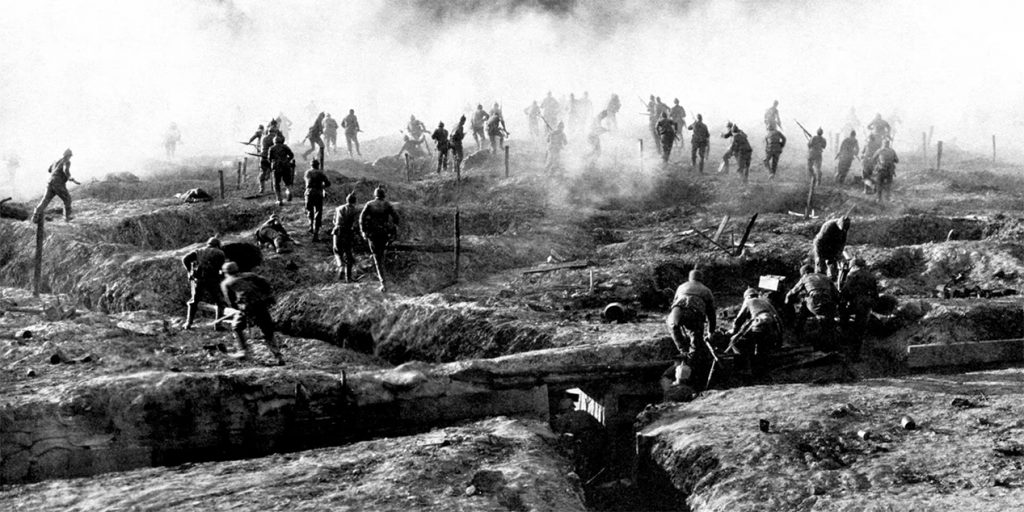
Pitting spears against the Gatling gun was hopeless. Zulu tactics were just a suicide note; the same would happen in the First World War, where horse versus tank skirmishes were as predictable, as one-sided and just as suicidal. Predictably, heroes, fools and the insane ignored those odds, fixed bayonets, went for it and mostly died.
Yet the notion of tea and medals lived on. Indeed, is it not sweet and fitting to die for one’s country?
Dulce et decorum est, Wilfred Owen said it best, but it’s not only the mechanics of war that have changed, but the mathematics too. Despite Owen’s verse, while there is hope, no matter how futile, you will have heroes.
Heroism requires the possibility of success, however slim. The Zulus could theoretically win. The WWI infantryman could theoretically survive. The Ukrainian and Russian “grunt” survives in the shorterm. That slim possibility is what allows sacrifice to mean something.
War has always been evolving, constantly getting more bloody, more efficient. Indeed, Dr Richard Gatling claimed he designed his gun to reduce the need for large armies and lessen casualties. It became quite the opposite. And we have almost reached the logical conclusion of that arms race.
We are at the confluence of three technologies currently accelerating the pace of change in war: AI, autonomous targeting systems, and drones. Combined, they are our generation’s Gatling gun. Thus, the age of the hero is dead.
The modern infantryman, despite their training, is the “new Zulu,” facing an adversary that cannot be suppressed, intimidated, negotiated with or stopped.
Thanks to technology, the modern battlefield is becoming the suicidal landscape of dystopian films and novels, and it’s only going to get worse. Troops are as bogged down by these new gadgets as was poor Tommy in his trench in World War I.
The tank was the logical conclusion to that problem, but as we are seeing in Ukraine, that is rapidly becoming the right answer to the wrong question.
Persistent, AI-driven overhead sensors (thermal, multispectral, acoustic) mean that if an object or human is visible to a sensor, it is immediately targeted and struck by low-cost FPV (First Person View) drones.
An AI swarm can identify, lock, and engage a target in milliseconds, whereas human reaction time is roughly 500ms to 1s. A mass-produced, autonomous drone can cost less than £500, while it costs hundreds of thousands of pounds each to train and equip human soldiers. The math makes the human an untenable liability on the battlefield.
Please don’t try telling me that the rules that supposedly govern how wars are fought, such as international law, the Laws of Armed Conflict and the Geneva Convention, will prevent the worst of this. Perhaps they once did. But recent events suggest otherwise.
Might is right. Gaza, Ukraine, Yemen. Look at the bodies. The rules exist to be laughed at by the winning side, simply ignored by anyone with sufficient firepower, the will to use it and political cover to do so.
It’s not that the ethical guardrails are broken. They were never really there in the first place. Logic dictates that the only sane conclusion for the nations that can afford to do so is to remove the human element from the battlefield, creating something of a conundrum for future poets.
It’s not that the “Old Lie” (Dulce et Decorum est) of Wilfred Owen’s seminal poem is no longer relevant; it’s just been made redundant.
The new lie isn’t just about the glory of death; it’s about the relevance of sacrifice. In an automated war, dying is just an error correction. This new war hasn’t just made death more likely. It has made meaningful sacrifice as statistically improbable.
Which brings me neatly back to the beginning of this piece. If statistics mean that the massed ranks of troops are dead before they have left the parade square, Trump’s draft is as daft and as pointless as pitting Zulu spears against Kalashnikovs.
Leave a Reply